
Winning Your Case
You can win a Social Security disability case with arthritis – Osteoarthritis or Degenerative Joint/Disc Disease, Rheumatoid Arthritis, Psoriatic Arthritis, or Gout. You must satsify Social Security’s –
You should review the criteria if you are not already familiar with them.
Once we cover how Social Security assesses arthritis medically, we will move to the next page to discuss how your arthritis causes Functional Limitations and how Social Security asseses your limitations to determine if you are disabled. Then we will move on to what Evidence you need to submit to prove your arthritis, your limitations, and other aspects of your disability case.
Arthritis Issues In A Social Security Disability & SSI Case
General
Arthritis may be the most common medical impairment in America. It limits functioning in nearly all aspects of a person’s life. Therefore, Social Security & SSI disability filings are a daily occurrence. There is one unique challenge in a disability case involving arthritis – there are really three types of disability arthritis cases. Each type requires specific medical findings to be found disabled.
Three Types Of Arthritis Cases
Type One. Type one is the “aches and pains” arthritis where a person complains to their doctor that they suffer primarily joint pain and stiffness. This can include one joint, several joints, or the whole body. Your doctor may, or may not, have diagnosed arthritis. Objective testing such as X-rays, MRIs, blood tests, and clinical evaluations by your doctor are largely or entirely normal. It is very difficult to win a disability case with this type of arthritis. If objective scans or clinical evaluations do not reveal an abnormality of a joint(s), Social Security will generally find your joints are normal – arthritis free, or at least, your arthritis is not severe enough to be disabling. This is true even if your doctor diagnoses arthritis. Social Security will find that your doctor’s opinion is not supported by medical evidence. Simply complaining of problems moving (e.g. walking, reaching, handling, etc.) or performing daily activities (e.g. cleaning, housework, errand-running, etc.) due to joint pain is not sufficient. This type of arthritis case is very common.
Type Two. You may or may not have a diagnosis of a specific type of arthritis, your objective testing (e.g. x-rays, MRIs, or blood tests) are normal, but you do have a diagnosis of general arthritis with supporting abnormal clinical findings (your doctors physical review of you during a visit). This type of arthritis disability case is also usually difficult to win since the objective testing is normal. However, in some situations, your case can be won on the basis of your abnormal clinical findings which must show –
- Swelling,
- Tenderness,
- Stiffness, and
- Reduced range of motion.
In severe case, abnormal clinical findings will include –
- Synovitis (joint deformity), and
- Weight loss.
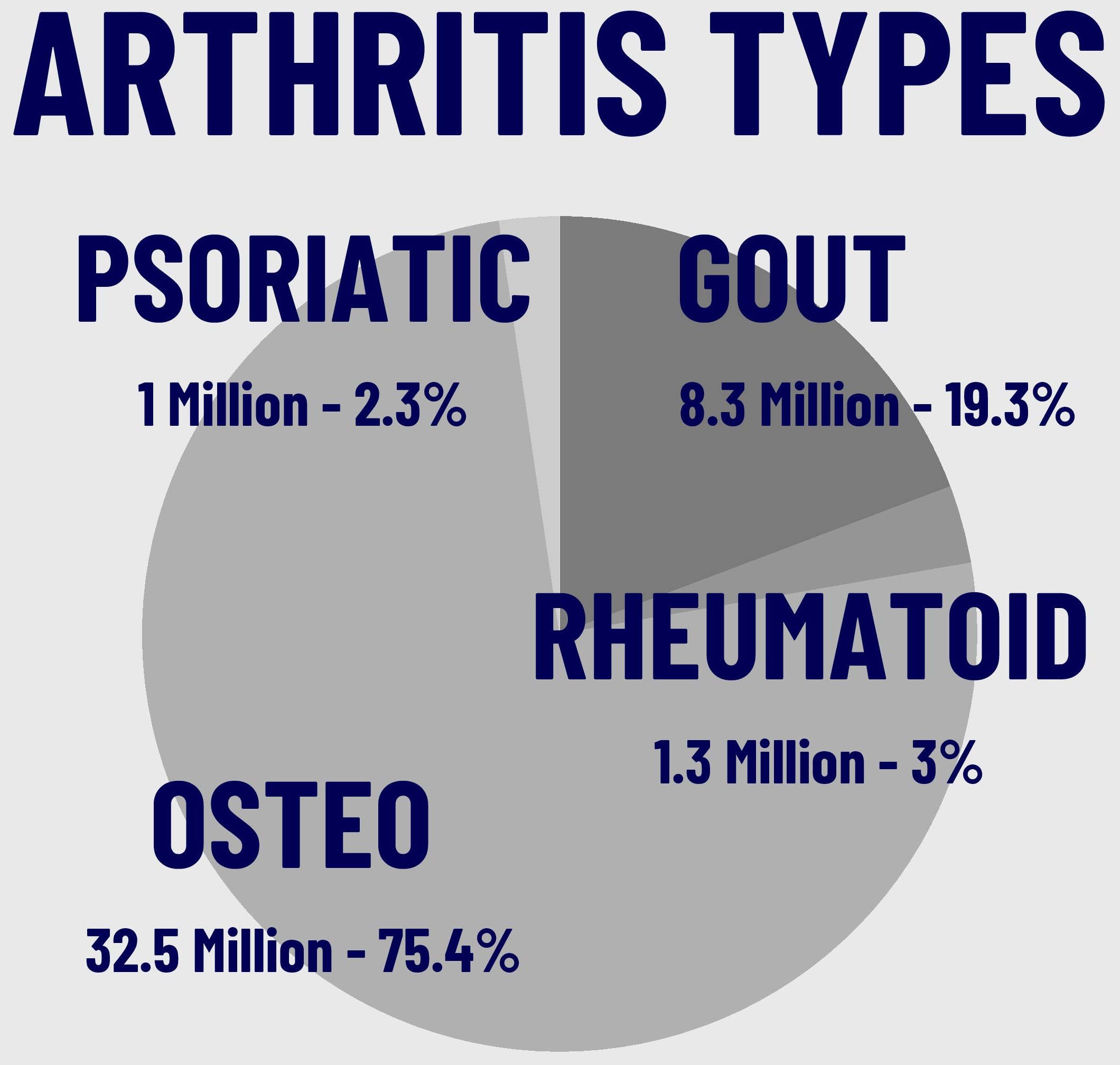
Type Three. You have a specific type of arthritis supported by abnormal x-rays, MRIs, or blood tests; and you have abnormal clinical evaluation findings. This is the strongest type of arthritis disability case. The four specific types of arthritis (each recognized by Social Security as a basis for disability) are as follows:
- Osteoarthritis or Degenerative Joint Disease (“wear and tear” breakdown of joint cartilage),
- Rheumatoid Arthritis (an autoimmune disorder and inflammatory process that attacks the lining of the joints),
- Psoriatic Arthritis (an autoimmune disorder and inflammatory process that attacks the joint cartilage), and
- Gout (build-up of uric acid in the joints).
The Arthritis Listings
Social Security does not have a specific listing for each of the four specific types of arthritis.
For osteoarthritis, there are three general Social Security listings:
- Joint dysfunction – Adult Listing 1.02 and Child Listing 1.02,
- Surgery of a large lower extremity joint – Adult Listing 1.03 and Child Listing 1.03, and
- Spine impairments – Adult Listing 1.04 and Child Listing 1.04.
For rheumatoid arthritis, psoriatic arthritis, and gout, the general Social Security listing is Inflammatory Arthritis: Adult Listing 14.09 and Child Listing 114.05. Both inflammatory arthritis listings require you or your child to demonstrate only one of the following four criteria:
- Regular swelling of upper and lower extremities and significant limitations,
- Joint swelling and organ or full-body symptoms,
- Ankylosing spondylitis with symptoms, or
- Arthritis that seriously affects your daily functioning.

Call Now For A Free Consultation!
We Are Committed To Helping You!
Existing Clients: (503) 639-6666
New Clients: (323) 247-9887